
Before the Battle

After the Battle
The knotweed will be back. I'll have to hit it hard 3 or 4 more times this year. Only when we get the next hard frost will the knotweed retreat until next year.
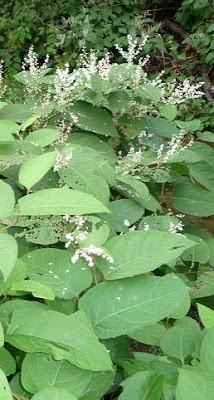
Japanese Knotweed
Japanese Knotweed is a non-native species which was brought from Asia. It is an extremely aggressive species. It can grow as much as 18 inches a week. It likes wet areas, like the side of creeks and areas of poor drainage. Japanese Knotweed can grow to be 8 feet tall. It can send roots down over 6 feet. I even found shoots growing into the second floor of the milk shed! Because its roots are so deep, it can’t be pulled. It does respond to some herbicides, but I did not want to use them near the creek.
Luckily, knotweed is easy to cut. Its stalk looks like bamboo, but is very soft and usually full of water. Cutting it with a string trimmer works, but the watery-filled stalk tends to spray water all over. I’ve found the best tool is an old-fashion scythe.

The Knotweed Slayer
I bought a scythe at an auction for $15. It was in good shape, and with a little tightening and blade sharpening, I was ready to tackle the knotweed. I have to cut the weed back every three weeks, or it grows so tall that we can’t see the creek. As long as you trim it, it stays in check. In time I also learned knotweed has 2 enemies – Japanese beetles and cold weather. It seems very few animals eat knotweed. At least Japanese beetles are good for something. As far as cold, once the first frost kicks in, the knotweed turns brown and dies back.
Now that I know what knotweed is, we see it all around the area. We were in Vermont last weekend visiting friends, and even noticed it there. I know I’ll never rid the property of knotweed (it’s all around every stream in the area). The battle of the knotweed won’t end – but I’ll keep fighting it.